.jpg)
Serial Killers Who Were Never Caught: The World s Most Elusive Criminals
Serial Killers Who Were Never Caught: The World’s Most Elusive Criminals
History is filled with criminal cases that continue to puzzle investigators decades after they occurred. While many serial killers have been identified and brought to justice, others managed to evade capture, leaving behind unanswered questions and unsolved murders. These elusive criminals have become the focus of countless investigations, documentaries, and true crime discussions.
Studying serial killers who were never caught helps experts understand investigative challenges, criminal behavior, and the importance of advances in forensic science.
Why Some Serial Killers Remain Unidentified
Not every criminal investigation ends with an arrest. In many historical cases, investigators faced significant obstacles, including limited forensic technology, lack of surveillance systems, and incomplete evidence.
Several factors contribute to unsolved serial murder cases:
- Crime scenes with limited physical evidence
- Witness accounts that conflict or are incomplete
- Crimes committed across multiple jurisdictions
- Advances in forensic science arriving years after the crimes
- Offenders who carefully planned their actions to avoid detection
These challenges have allowed some of history's most dangerous offenders to remain unidentified.
The Zodiac Killer
Among the most famous unidentified criminals is the Zodiac Killer. Active in Northern California during the late 1960s, the killer sent cryptic letters and coded messages to newspapers while claiming responsibility for multiple murders.
Despite decades of investigation and numerous suspects, authorities have never officially confirmed the killer's identity. The Zodiac case remains one of the world's most famous cold cases and continues to attract researchers and amateur investigators.
Jack the Ripper
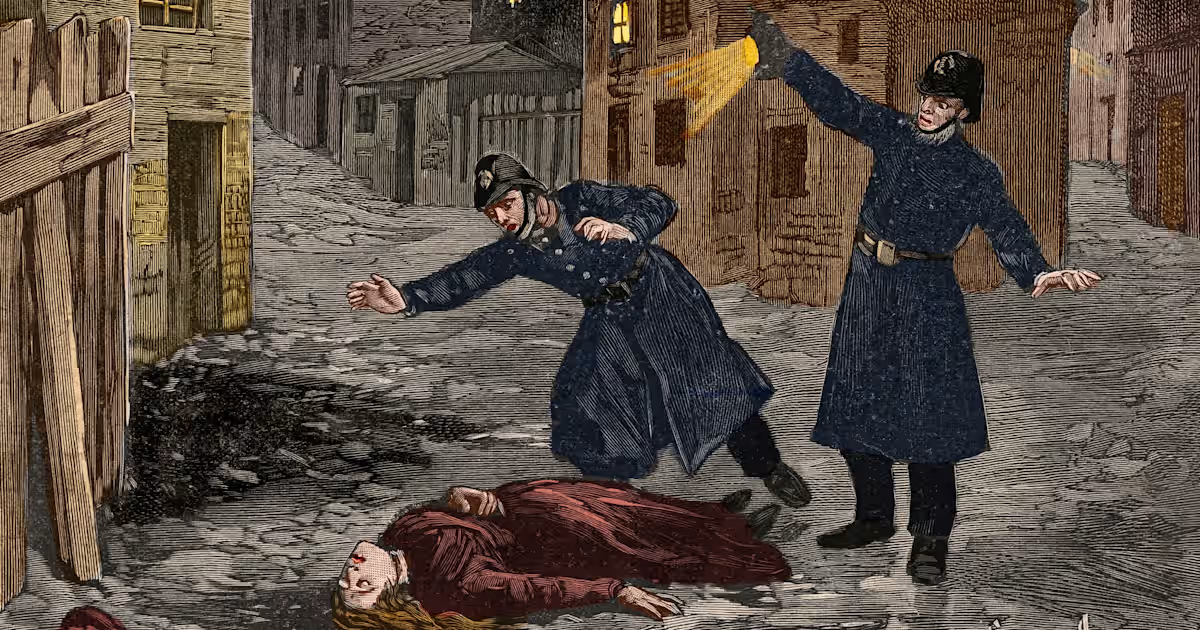
Another legendary unsolved case involves Jack the Ripper, who terrorized the Whitechapel district of London in 1888. The killer murdered several women and disappeared without ever being identified.
Numerous theories have emerged over the years, but no conclusive evidence has established the identity of the murderer. The case remains one of history's greatest criminal mysteries.
The Phantom Killer
The unidentified offender known as the Phantom Killer attacked several victims near Texarkana in 1946. The crimes created widespread fear throughout the region and led to one of the largest manhunts of its time.
Although investigators interviewed many suspects, no one was ever convicted, leaving the case officially unsolved.
Why These Cases Continue to Fascinate People
Unsolved serial murder investigations continue to capture public attention because they combine mystery, psychology, and criminal investigation. Unlike solved cases, they leave room for unanswered questions and competing theories.
People remain interested because they want to understand:
- How offenders avoided capture
- Whether modern forensic science could solve the case
- What evidence remains undiscovered
- How investigations have evolved over time
This ongoing curiosity has made unsolved crimes one of the most popular subjects in true crime media.
Advances in Modern Forensic Science
Today's investigators have access to technologies that were unavailable decades ago. DNA analysis, genetic genealogy, digital databases, and advanced forensic techniques have helped solve numerous cold cases that once seemed impossible to crack.
Although some historical investigations remain unresolved, new scientific methods continue to offer hope that additional evidence may eventually identify unknown offenders.
Lessons for Criminal Investigations
Cases involving unidentified serial killers have changed the way law enforcement investigates violent crime. They have encouraged better cooperation between agencies, improved crime scene preservation, and greater reliance on behavioral profiling and forensic evidence.
Each unsolved investigation contributes valuable knowledge that can help prevent future crimes and improve investigative practices.
Yorumlar